New RCM & 2% GST TDS Applied on Purchase of Battery Scrap and E Waste from 1st November 2026
A massive, long-awaited breakthrough that lead recyclers and the battery industry have aggressively petitioned and struggled for is finally a reality. To eliminate 'fake invoicing' and the risk of buyers getting their Input Tax Credit (ITC) blocked due to unregulated purchases from unregistered scrap dealers, the GST system has been structurally overhauled. The implementation of reverse charge mechanism (RCM) for unregistered purchases and a mandatory 2% GST TDS for registered transactions will permanently filter out unscrupulous billing circles, allowing everyone to do business without fear.
 Arvind Mohan

Freedom from Fake Billing & Legal Hassles: Historical Victory of a Long-Struggled Demand by the Lead & Battery Scrap Industry
1. Background and Statutory Notifications
Following recommendation of the GST Council, the Ministry of Finance (Department of Revenue) issued three crucial notifications on 27 October 2026, set to take effect on 1 November 2026. These regulations reshape how transactions involving Battery Scrap, Electrical & Electronic Waste (HSN 8549), Plastic Scrap, Tyre Scrap, and Metal Scrap are monitored and taxed, aiming to secure the entire supply chain and curb tax evasion.
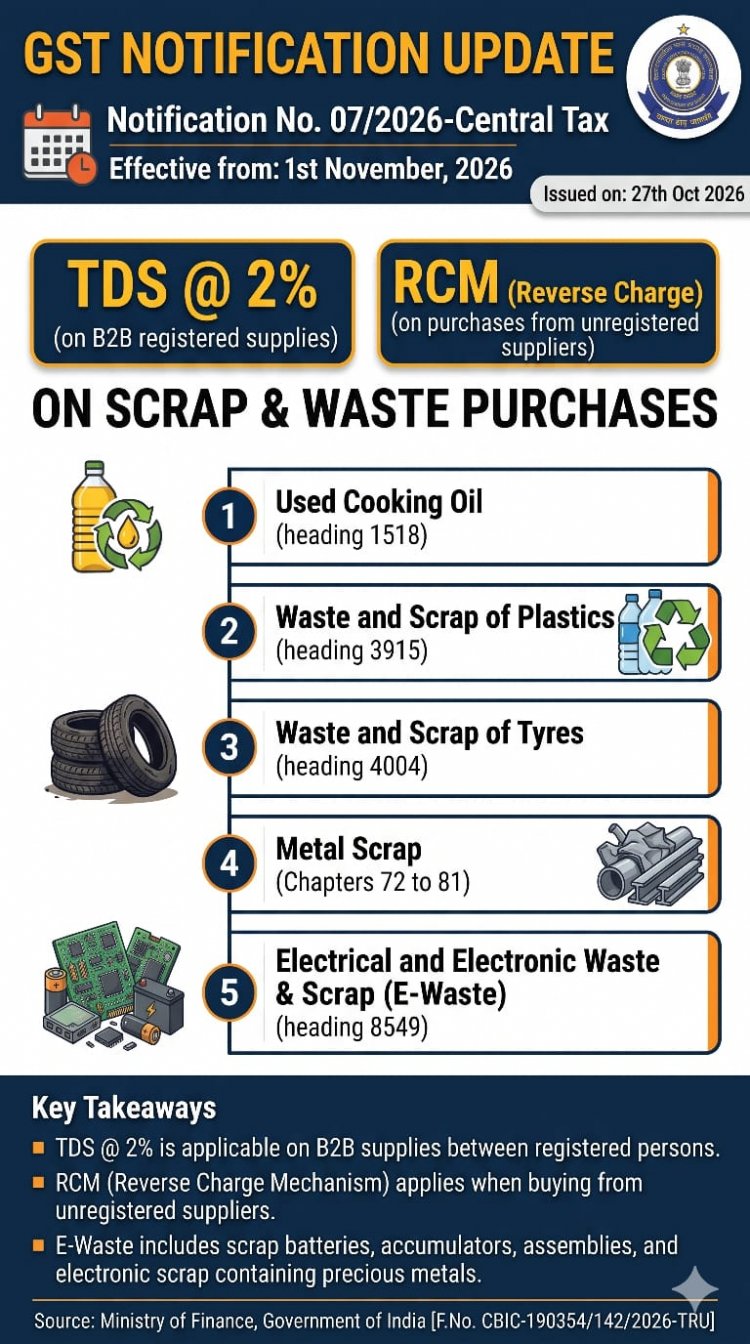
Image: Official infographic update for RCM and 2% GST TDS on scrap and waste purchases effective 1st November, 2026
Highlights of the 1 November 2026 Regulatory Framework:
- Notification No. 04/2026-Central Tax (Rate): Imposes the Reverse Charge Mechanism (RCM) under Section 9(3) of the CGST Act on HSN 8549 scrap purchased from any unregistered supplier.
- Notification No. 07/2026-Central Tax: Mandates a 2% GST TDS on HSN 8549 scrap procured from registered suppliers under Section 51.
- Notification No. 06/2026-Central Tax: Substitutes exemptions under Section 23(2) to terminate standard registration reliefs for suppliers involved in the scrap trade.
2. Scenario 'A': Scrap Purchases from Unregistered Sellers (RCM)
If a registered buyer or recycler purchases battery scrap (HSN 8549) from any unregistered vendor, the seller cannot charge GST. Instead, the buyer has to deposit the GST directly to the Government under the Reverse Charge Mechanism (RCM). Since the buyer takes over the tax obligation, this mechanism completely eliminates the risk of accepting bogus bills.
Buyer Compliance Checklist:
- GST Registration Requirement: The buyer must be registered under GST.
- Compulsory Self-Invoicing: Since the seller is unregistered, the buyer is legally required to issue a self-invoice under Section 31(3)(f) of the CGST Act to document the purchase.
- Issuance of Payment Vouchers: The buyer must issue a payment voucher to the unregistered seller at the time of paying them, as required under Section 31(3)(g).
- Cash-only GST Deposit: RCM GST liability can only be settled in cash through the Electronic Cash Ledger on the GST Portal. Existing Input Tax Credit (ITC) cannot be utilized to offset this payment.
- Return Disclosure on GSTR-3B: The buyer has to declare the transaction and its respective RCM tax liability under Table 3.1(d) of the GSTR-3B return.
- Availability of Input Tax Credit (ITC): After depositing the RCM GST in cash, the buyer can claim 100% ITC on it in GSTR-3B (Table 4(A)(3)) subject to standard eligibility rules.
- TDS Exemption: No GST TDS under Notification No. 07/2026 needs to be deducted for any purchases from unregistered suppliers handled under RCM.
Practical Example of RCM (Assuming an 18% Tax Rate):
Assume you buy battery scrap (HSN 8549) worth ₹10,00,000 from an unregistered local vendor or aggregator and the applicable GST is 18%:
| Particulars | Amount (₹) | Compliance Treatment |
|---|---|---|
| Taxable Value of Battery Scrap (Value of Purchase) | ₹10,00,000 | Amount paid directly to the unregistered vendor |
| 18% RCM GST Payable on Purchase | ₹1,80,000 | Liability taken over by the buyer |
| GST Paid to Government by the Buyer (in cash) | ₹1,80,000 | Paid through cash ledger on GST Portal |
| Claimable Input Tax Credit (ITC) for the Buyer | ₹1,80,000 | 100% recoverable as ITC (subject to normal rules) |
3. Scenario 'B': Purchases from Registered Sellers (2% GST TDS)
If the seller of battery scrap is registered under GST, they will raise a standard Tax Invoice charging GST. RCM is not applicable in this case. However, the buyer is required to deduct GST TDS at the rate of 2% under Section 51 of the CGST Act, as mandated by Notification No. 07/2026-Central Tax.
Key Legal Rules for GST TDS on Scrap:
- Eligibility Threshold: GST TDS applies only if the total taxable value of the supplies under a contract exceeds ₹2,50,000. Contracts at or below ₹2,50,000 are exempt from TDS.
- TDS Rate Distribution:
- Intra-State Purchases (within state): 1% CGST + 1% SGST (Total 2%)
- Inter-State Purchases (between states): 2% IGST (subject to Place-of-Supply regulations)
- Base Value for Calculation: The 2% TDS must be calculated strictly on the taxable value of scrap. The GST amount and cess on the invoice are excluded from this calculation.
- Obtaining Separate TDS Registration: To deduct and deposit this tax, buyers must obtain a separate GSTIN as a TDS Deductor using Form GST REG-07 on the portal. An ordinary GST registration is not sufficient.
- Filing & Deposit (GSTR-7): The buyer must deposit the deducted TDS amount to the Government and file the Form GSTR-7 by the 10th of the following month.
- TDS Credit Transfer (Form GSTR-7A): After GSTR-7 is filed, the seller receives this credit in their Electronic Cash Ledger, generating Form GSTR-7A. Sellers can use this credit to pay their own tax liabilities.
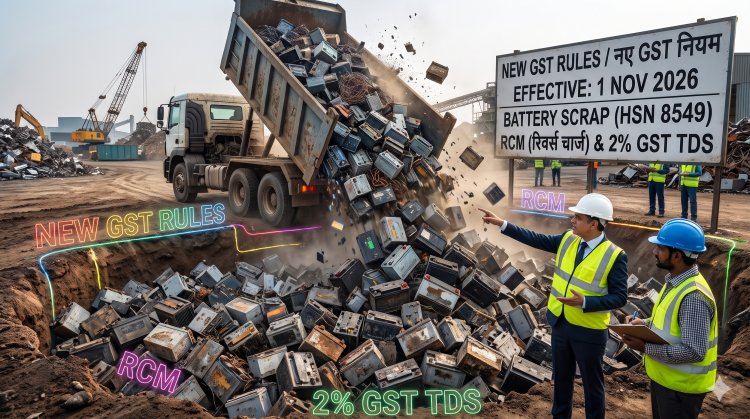
AI image : Safe incoming of scrap batteries via truck, being registered in compliance with the new GST rules (RCM and 2% TDS)
Practical Example of TDS Calculation and Invoice Breakdown:
If your registered business buys battery scrap (HSN 8549) with a taxable value of ₹10,00,000 from a registered supplier, assuming 18% GST:
| Particulars | Amount (₹) | Impact and Treatment |
|---|---|---|
| Taxable Value of Battery Scrap | ₹10,00,000 | Base Value |
| GST at 18% (charged on invoice by supplier) | ₹1,80,000 | Direct GST added |
| Total Invoice Value (billed by seller) | ₹11,80,000 | Total Invoice amount |
| GST TDS @ 2% (2% of taxable value) | (-) ₹20,000 | Buyer to deposit through GSTR-7 |
| Net Amount Payable to Supplier | ₹11,60,000 | Amount paid through bank to vendor |
4. Roles and Guidelines for Buyers, Sellers, and Recyclers
A. For Battery Scrap Buyers & Recyclers:
- Examine the Trader's Back-end Supply Chain: Confirm your supplier's GST status and ensure they have genuine transaction logs. If buying from a trader, double-check whether they have correctly cut TDS on their incoming transactions, and ensure they are appropriately registered as a GST TDS deductor.
- Strict HSN Validation: Assess that the received items exactly match the specifications of HSN 8549 (electrical, electronic, and battery scrap) before processing.
- Exact GST Rate Verification: Do not assume a flat or generalized rate of tax because of RCM. Ensure the exact GST rate is determined depending on the class of battery scrap.
B. For Battery Scrap Sellers (Scrap Dealers):
- Exemption Withdrawal (Notification No. 06/2026-CT): The Government has substituted exemptions under Section 23(2) of the CGST Act for individuals supplying notified scrap items. This effectively revokes regular exemption relief, mandating GST registration for scrap trade based on applicable volume or trade standards.
- Filing for TDS Credit: The 2% TDS deducted will appear on your GST portal's Electronic Cash Ledger after your buyer files Form GSTR-7. Use this directly to pay your forward GST output tax.
5. Other Scraps and Waste covered under this Combined RCM-TDS Framework
To curb unauthorized transactions, the Government has unified the compliance frameworks of the following waste and scrap categories alongside battery scrap, effective 1 November 2026:
| HSN / Chapter | Scrap Type / Description | Compliance Action Required |
|---|---|---|
| HSN 1518 | Used Cooking Oil | RCM on unregistered, 2% GST TDS on registered |
| HSN 3915 | Waste and scrap of plastics | RCM on unregistered, 2% GST TDS on registered |
| HSN 4004 | Waste and scrap of tyres | RCM on unregistered, 2% GST TDS on registered |
| Chapters 72 to 81 | Metal Scrap (iron, copper, aluminum, etc.) | 2% GST TDS on registered, pre-existing RCM rules |
| HSN 8549 | Electrical, electronics waste, and battery scrap | RCM on unregistered, 2% GST TDS on registered |
6. Mandatory Checklist for Businesses and GST Professionals before 1 November
To guarantee smooth operations, prevent penalties, and align accounting with the new legal requirements, implement these 7 actions before the 1 November 2026 deadline:
- Map Vendors by Registered / Unregistered Status: Collect and verify GST numbers of all scrap providers, cataloging them into distinct 'Registered' and 'Unregistered' workflows.
- Update HSN Codes and Tax Ledger Parameters: Modify ERP and accounting system software to support 8549, 1518, 3915, 4004, and chapters 72-81 with their correct taxation rules.
- Define Separate Purchase Workflows: Create dual purchase paths inside the ERP - (A) RCM Workflow for Unregistered Purchases, and (B) GST TDS Workflow for Registered transactions.
- Install RCM Document & Invoice Controls: Configure accounting modules to enforce self-invoices (Section 31(3)(f)) and generate payment vouchers (Section 31(3)(g)) instantly upon transaction.
- Acquire GST TDS Registration (GST REG-07): If contract values with registered sellers exceed the threshold, file the application in Form GST REG-07 to act as a TDS deductor.
- Assure GSTR-7 Filing and Credit Return readiness: Ensure that you are capable of submitting Form GSTR-7 by the 10th of every following month, auto-transmitting GSTR-7A credits to sellers.
- Perform Comprehensive Pre-Nov 1 Reconciliations: Verify and close balance ledgers, match records with vendor masters, and address historical mismatch trends before starting new compliances.
Conclusion and Expert Recommendation
Securing the battery scrap and e-waste sector with RCM and a 2% GST TDS is a monumental step toward dismantling fake invoicing while protecting compliant players. The transition guarantees full safety from retrospectively blocked Input Tax Credit (ITC). To reap the benefits without operational disruptions, scrap processors, traders, and buyers must immediately implement strict vendor categorization, proper invoice tracking, and reliable GSTR-7 reporting mechanisms.
|
|
Co Author: Naveen Prakash Sharma Executive Director Gravita |